
Laerdal Little Anne QCPR
The Little Anne QCPR training manikin provides learners with feedback so they can improve on their CPR skills, during the training session.
- Little Anne QCPR Manikin
- Soft Pack/ Training Mat
- 2 Manikin Faces
- 2 Airways
- 6 manikin wipes
- Jacket for manikin
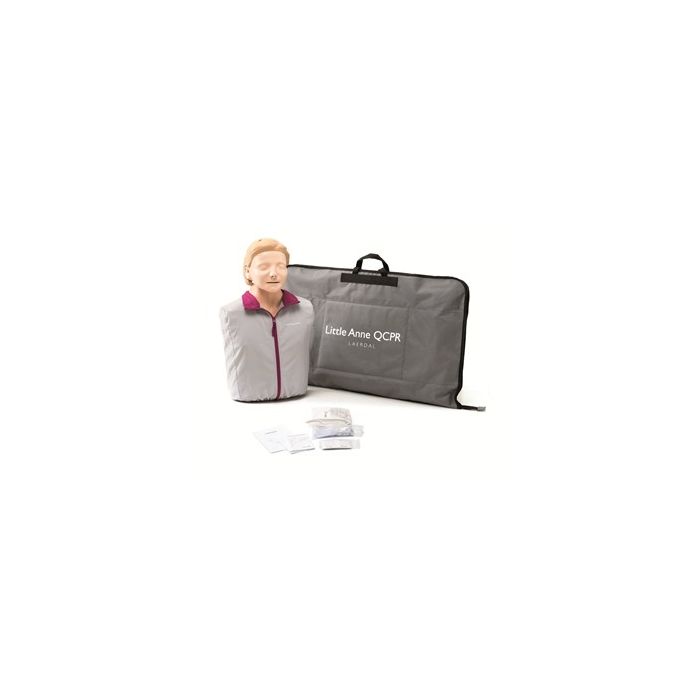
Laerdal's Little Anne QCPR training manikin provides learners with feedback on the quality of the CPR they're providing the manikin with. This allows them to improve their CPR skills whilst ensuring their confidence in the skill they're learning. Little Anne QCPR uses Bluetooth Smart technology that connects with tablets and smartphones to provide feedback that will help the trainee to prepare for a real-life emergency situation.
Key Features
More Information
For further information about this product, get in touch with a member of our team on 0161 776 7422.
| MDR Approved | Yes |
|---|---|
| Defib Brand | Laerdal |
| FDA Approved | No |
| Dangerous Goods | No |
The Little Anne QCPR training manikin provides learners with feedback so they can improve on their CPR skills, during the training session.
What is the Laerdal Little Anne QCPR?
The Laerdal Little Anne QCPR is a training manikin designed to simulate an unresponsive casualty in a Sudden Cardiac Arrest (SCA) emergency. Its anatomical design enables learners to confidently practise and apply different techniques used during life-saving Cardiopulmonary Resuscitation (CPR), including nose pinch, head tilt/chin lift, and jaw thrust motions to open the airways. Paired with the QCPR app, the training manikin provides detailed feedback on chest compression depth and rate, helping responders improve their technique and build confidence in their emergency response.
What is the story behind the Laerdal Little Anne’s invention?
Laerdal’s Little Anne is a development of the original Resusci Anne CPR manikin, first created in 1960 by toy maker Åsmund S. Laerdal. The manikin was designed to improve CPR training and public awareness, modelled after the face of an unidentified young girl who drowned in the River Seine around 1900, known as L’Inconnue de la Seine. Since its creation, the manikin has evolved through several updates, leading to the Laerdal Little Anne we use today, now equipped with Bluetooth connectivity for performance tracking via the QCPR app.
How do I use the Laerdal Little Anne QCPR training manikin?
To begin a training session with the Laerdal Little Anne QCPR, insert the batteries and perform one chest compression to activate the manikin. You will hear a single beep to confirm it is switched on.
Next, open the QCPR training app on your phone or tablet and select the Little Anne QCPR from the list of available Bluetooth devices.
To begin CPR practice, interlock your hands and place the heel of your bottom hand in the centre of the manikin’s chest. Perform compressions at a depth of approximately 5cm, aiming for a rate of 100–120 compressions per minute. Ensure the chest fully recoils between compressions.
If practising rescue breaths, deliver two steady breaths into the manikin’s mouth after every 30 compressions. Look for visible chest rise as a sign of effective ventilation.
Continue CPR and rescue breaths until the session ends or the manikin indicates a successful response with a visible chest rise.
How do I maintain my Laerdal Little Anne QCPR training manikin?
Maintaining your Laerdal Little Anne QCPR training manikin is straightforward and essential for ongoing effective use. After each training session, remove and replace the disposable lungs to ensure readiness for the next learner. Clean the face, mouth and chest using manikin wipes or a mild soap and water, taking care not to submerge the manikin. Replace the batteries once depleted to maintain realistic movement and performance feedback during training.
Who is the Laerdal Little Anne QCPR training manikin designed for?
Laerdal’s Little Anne QCPR is designed for anyone looking to improve their Basic Life Skills (BLS) for an emergency. It is lightweight, making it convenient for transportation, and user-friendly with full instructions for use provided. The QCPR app also offers a host of training videos and tutorials for further training, allowing learners to benefit from useful information and tips for effective practice.


