
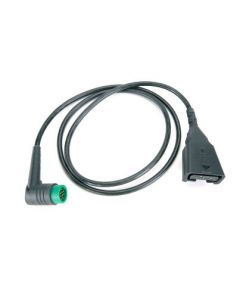
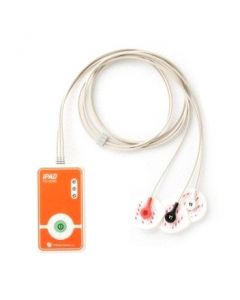
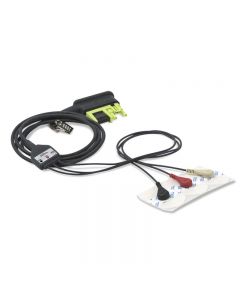
The Role of ECG Cables in Cardiac Care
ECG leads are an accessory designed to transmit key defibrillator usage data securely and reliably following an emergency. They are also used to enhance ECG monitoring capabilities, equipping healthcare professionals with the support needed to deliver precise, informed treatment in a Sudden Cardiac Arrest (SCA).
At defibshop, we offer a selection of ECG wires from Physio Control, CU Medical, and ZOLL, compatible with selected Automated External Defibrillators (AEDs).
Features of ECG Wires
- Multiple leads – ranging from 3 to 12, enabling different views (‘leads’) for heart activity in ECG monitoring.
- Secure attachment – attached to the defibrillator/monitor using the main cable, with the lead wires attached to electrodes placed on the casualty’s skin.
- Durable, flexible design – made from materials such as silicone, thermoplastic polyurethane (TPU), or PVC.
- Colour-coded cables – to guide correct placement on the casualty for accurate monitoring.
- Precise signalling – transmitting electrical signals to the defibrillator for monitoring, processing, and recording heart data.
Steps for Using An ECG Cable
To monitor a casualty’s heart rhythm with your ECG cable:
- Locate the ECG input port on your defibrillator.
- Connect the ECG cable, ensuring it is secure.
- Prepare the casualty, ensuring the skin is clean and dry for the electrodes.
- Connect electrodes to the corresponding leads of your cable, following the instructions provided and/or the colour code indicated.
- Once the electrodes are in place, power on your defibrillator/monitor and view the ECG waveform on the display.
To transfer data from your defibrillator following an SCA, first ensure your chosen device has the correct software installed to interpret the data. Consult your defibrillator manual for more information. Once installed, follow these steps:
- Connect the ECG cable to the receptacle on your defibrillator.
- Insert the other end into your computer or other device.
- Follow the instructions for transferring data from your defibrillator.
- Verify data using the software to ensure accuracy and reliability.
Make sure the ECG cable and software is compatible with your specific defibrillator. Connection methods vary depending on your AED model, so we recommend following the instructions provided in your owner’s manual.
Explore other defibrillator accessories available in our Accessories range, or for any questions feel free to reach out to our expert team.
What are the 12 leads of an ECG?
The 12 leads of an ECG provide specific viewpoints of the heart’s electrical activity. There are six leads that focus on the heart’s front and sides (V1-V6), and six other leads that observe activity from different angles (I, II, III, aVR, aVL, and aVF).
What does V1, V2, V3, V4, V5, and V6 mean on an ECG?
These refer to different placements around the front and sides of the heart, and are intended for medical professionals performing AED monitoring:
- V1 & V2 = RV
- V3 & V4 = septum
- V5 & V6 = L side of the heart
Do all defibrillators offer ECG monitoring?
No. Not all defibrillators include an ECG feature. This is usually found on more advanced AEDs, suitable for medical professionals or experienced first-aid responders. At defibshop, we offer several AEDs with ECG functionality, including the Defibtech Lifeline ECG Semi-Automatic, the Physio Control LIFEPAK 1000 Semi-Automatic with ECG & Manual Override, the ZOLL AED 3 BLS, and more.